What to see at Les Invalides, in order
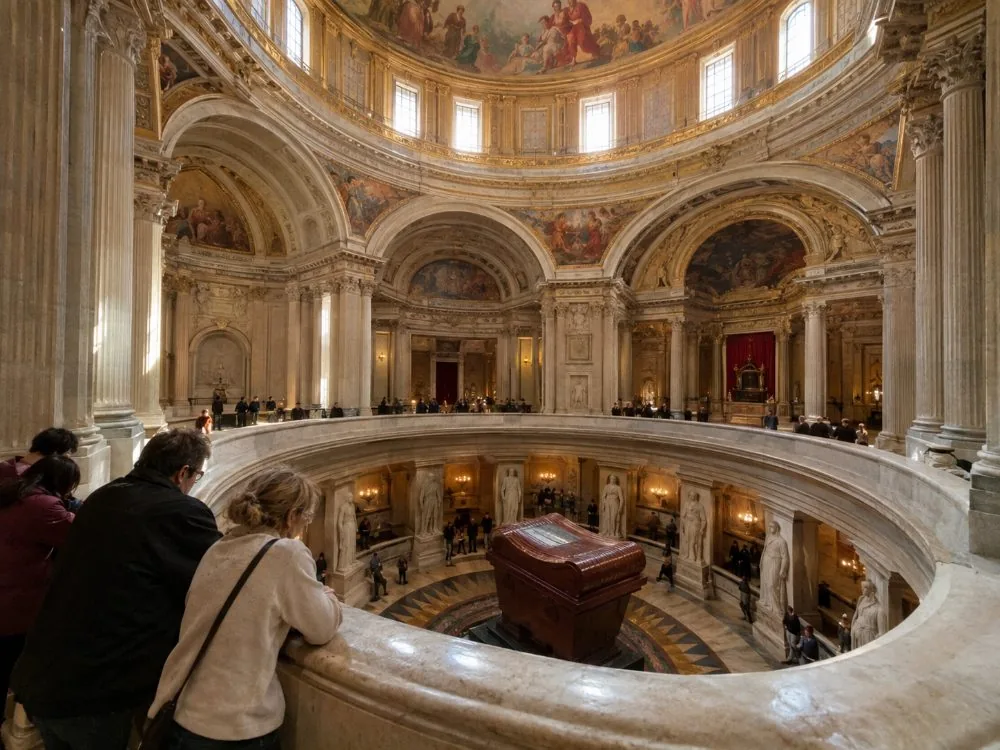
1. The Dôme and the tomb
Start here, always, and as early as you can. It is the only space at Les Invalides where the crowd genuinely changes the experience: the circular rail on the upper level is narrow, and by midday you are looking over shoulders. First thing in the morning you have the crypt to yourself. The full sequence is on the tomb page.
2. The Saint-Louis cathedral
It costs nothing, it is two minutes away, and it is empty. A great white nave, galleries covered with flags taken from the enemy, the atmosphere of a military parish. Fifteen minutes is enough, and those fifteen minutes are among the best on the site. See its page.
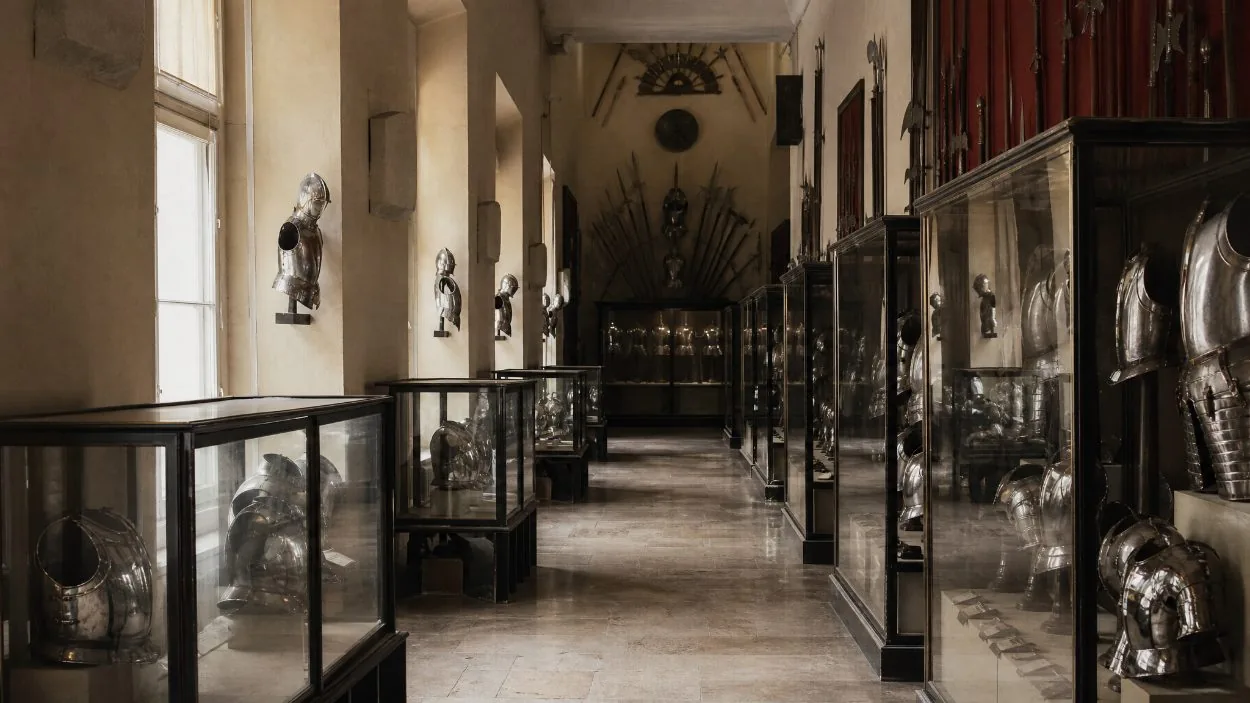
3. The armour and old weapons
The west wing, on the ground floor: full harnesses, parade armour, edged weapons and firearms from the 13th to the 17th century. It is the most immediately legible part of the museum, the one that works best with children, and the shortest. Allow forty-five minutes.
4. The relief maps, under the roof
Go up. Really. The Museum of Relief Maps occupies the attics of the east wing: a run of nearly dark rooms holding scale models of fortified towns the size of banqueting tables, commissioned from Louis XIV onwards to plan sieges. It is the strangest object in the building, half of all visitors do not know it exists, and it is what people remember six months later. See the relief-maps page.
5. Louis XIV to Napoleon III, then the two World Wars
The two great historical departments, in that chronological order. The first holds the Napoleonic story itself — uniforms, the hat, the grey coat, objects from Saint Helena — and is the natural continuation of the Dôme. The second, covering 1871 to 1945, is the densest and longest in the museum: you walk into it tired if you keep it for last, which is nonetheless the only sensible place for it.
6. The Order of the Liberation and the de Gaulle Historial
Two newer, plainer spaces, almost always quiet. The Museum of the Order of the Liberation tells the story of the Companions; the Charles de Gaulle Historial, in the basement, is an audiovisual installation that needs a good half hour and cannot be skimmed. See the Order of the Liberation and the Historial.
If you only have two hours, do the Dôme, the cathedral and the armour, and go up to the relief maps for ten minutes. Skipping the two World Wars is frustrating but honest; skimming all five spaces leaves you with no memory at all.
 Most booked
Les Invalides: Napoleon’s Tomb & Army Museum Entry
 8 people maximum
Napoleon’s Tomb & Invalides Small-Group Guided Tour
 Entry reserved
Les Invalides & Napoleon’s Tomb Guided Tour
Book
The ticket below opens this whole route. Suggested durations, section by section, are on the how-long page.
A reminder: what you book above is the ticket that opens the Army Museum, the Dôme and the tomb. The great courtyard and the Saint-Louis cathedral stay free to enter, with no ticket at all.
Frequently asked questions
What should you start with?
The Dôme and the tomb, as early in the day as possible: it is the only space where the crowd really spoils the visit.
What to see with only one hour?
The Dôme, and the Saint-Louis cathedral on the way out. Nothing else; the rest needs time.
What do visitors miss most?
The relief maps, under the roof. See this page.